New use for those plastic shopping bags! Midland County Road Commission brings recycled plastics to the paving process

You’ve emptied your groceries into the refrigerator, and now you’re left with a mound of plastic bags sitting on your counter. They’ll inevitably end up lying around the house – or stuffed into your garbage can. But what happens to those plastic bags once they go in the recycling? In Midland County, that plastic may end up being converted into the road beneath your feet.

Terry Palmer, PE, Midland County Road Commission (MCRC) managing director, was excited about a new way to recycle plastic.

“I’m always up for something new,” Palmer said. “The day I was running over to one of the job sites to check on a paving project, I was following a garbage truck that had some of these plastic bags billowing out from it and I thought ‘Huh, we might be able to take care of that problem.”

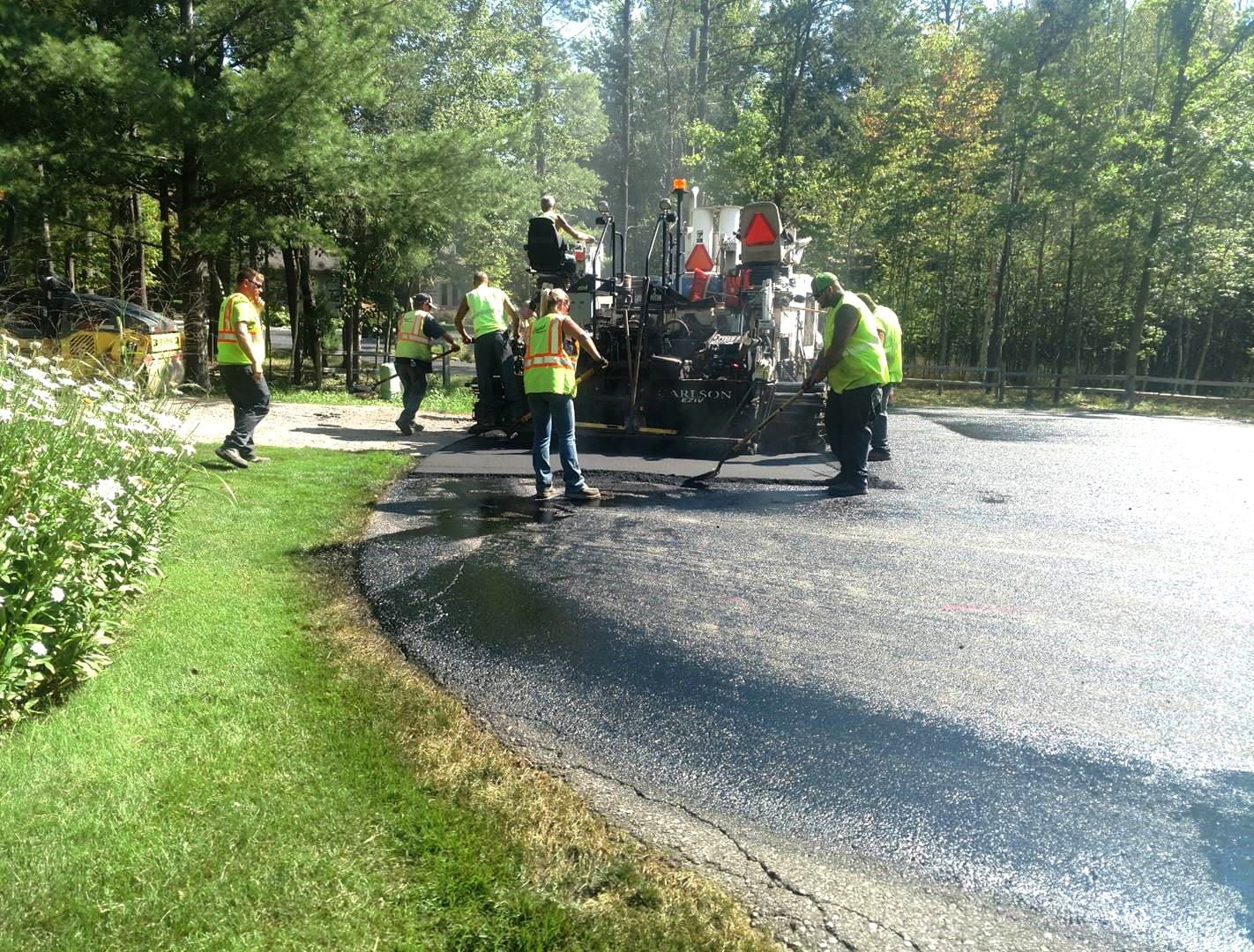
This summer, MCRC paved the first public asphalt road in the U.S. composed of plastics, additive and pavement fabric. Recycling plastic bags and food-grade foam into hot mix asphalt (HMA) is a relatively new concept that’s growing in popularity. The process offers road agencies an innovative, unique way to do their part in conserving the environment.

“They tell us this process uses the equivalent of 117,000 plastic bags per mile of paving, so in essence we gave the equivalent of 300,000 plastic bags new life in these road projects this summer,” Palmer said.

MCRC paved segments of four different roads with recycled material – an ultrathin HMA overlay, and three 1.5”-2” thick HMA overlays used for worse conditions. Over the next few years, the new road segments will be monitored and compared with other roads paved in summer 2019.

To learn more, read the Winter 2019 edition of Crossroads, the quarterly journal of the County Road Association (CRA) of Michigan, which can be viewed digitally or downloaded at https://micountyroads.org/newsroom/crossroads/.

Houghton County Road Commission is restoring order after 2018 weather damages

Neighborly kindness takes on a whole new meaning when your next-door neighbor offers you a ride on his tractor. On June 15-17, 2018, this scene wasn’t uncommon in Houghton County. Father’s Day weekend brought the “1,000-year storm,” and people across the county joined the Houghton County Road Commission (HCRC) in transporting residents to safety.

“They [the residents] weren’t asking ‘what can you do for us?’” Kevin Harju, PE, engineer-manager of the HCRC, said. “They were asking, ‘what can we do for you?’ Of course, we’re still a long way from recovered from the flood, but we’ve been working on it. The funding has been an issue, but everyone understands that it’s going to take a few years to recover from such a big event.”

With over seven inches of rain falling in just three days, Houghton County sustained significant damage, including 60 sinkholes, 150 road washouts and 150 damaged roads. Landslides, boulders and debris blocked access to some residents’ homes. Some roads were closed for days. Now 18 months later, recovery is three-quarters complete, and residents continue to offer their support.

“We had approximately $22.5 million in damage on our federal aid system,” Harju said. “We’ve got probably 60-70% of that completed and we still have some jobs we plan to finish before winter. On our local system with FEMA, we have about $5 million of work completed, so that’s far less than the $16 million of needed repairs on the local system.”

Houghton County hopes it won’t see the need for tractors as rescue vehicles anytime soon. But the HCRC knows it can count on residents to step up to the plate should the need ever arise.

Houghton County’s Father’s Day storm is featured in the Winter 2019 edition of Crossroads, the quarterly journal of the County Road Association (CRA) of Michigan, which can be viewed digitally or downloaded at https://micountyroads.org/newsroom/crossroads/.

Dickinson County Road Commission pioneers recycled tire technology in Upper Peninsula 

What happens to old tires once they’ve been discarded? While many may end up in the landfill, in Dickinson County, they may just end up beneath your wheels.

If you’ve been to Dickinson County, there’s a chance you’ve driven on recycled tire asphalt. The Dickinson County Road Commission (DCRC) is the northernmost agency in Michigan to experiment with recycled tires, or engineered crumb rubber (ECR). According to Lance Malburg, PE, DCRC county highway engineer, the county “has a culture that is open to exploring new ways to do things.”

While warmer-climate states have used ECR in roads, the concept is relatively new. ECR-hot mix asphalt (HMA) has been proven to offer a smoother, quieter ride and last longer than traditional asphalt. It is also more economical and flexible in formula, and provides a use for old tires.

For Dickinson County, collaboration is key. The county’s proximity to Michigan Technological University has led to fruitful partnerships and advancements in road construction.

“Being so close to Michigan Tech, we try to take advantage of working with the University on new ideas,” Malburg said.

“This particular project came about because it was something a professor at Michigan Tech had been researching and wanted to study in the real environment. Dickinson put in $250,000, we received a $300,000 grant and Michigan Tech contributed $100,000. That’s relatively unheard of for the University.”

DCRC’s ECR-HMA project is on County Road 607, north of Iron Mountain. Composed of three half-mile sections, the project combines two segments of “dry mix” ECR with one segment of traditional asphalt as the experimental control.

CR 607 was completed this past June, although it will be months before the DCRC can analyze the results of the ECR HMA technology. However, Michigan Technological University completed early audio tests, which showed improvement in the road noise. Ultimately, this technology could provide UP residents with a better driving experience.

“With the process being more efficient, county residents can get out and enjoy improved roads more quickly than with traditional methods,” Malburg said.

For more about Dickinson County’s integration of ECR roads, read the Winter 2019 edition of Crossroads, the quarterly journal of the County Road Association (CRA) of Michigan, which can be viewed digitally or downloaded at https://micountyroads.org/newsroom/crossroads/.

Ottawa County Road Commission fosters innovation and collaboration out on its roads


Where you belong. It’s the slogan of Ottawa County, and residents will tell you that statement rings true. The Ottawa County Road Commission (OCRC) lives up to this reputation by seeking continuous input from its townships. For the OCRC, this feedback is crucial to the development of its Strategic Improvement Plan.

“For us, this plan is what it’s all about: It helps coordinate with our local partners so we don’t duplicate with our efforts, and we have minimal disruption for the traveling public,” Brett Laughlin, PE, OCRC managing director, said. “If we were to tear up a road after we just paved it to accommodate a drain improvement or another facility – it just looks bad and is inefficient.

“By having a future plan, we’re able to coordinate with utilities and other projects impacting the roadway. It may take longer to finish the job, but drivers do not experience double disruption.”

Since 2008, Ottawa’s Strategic Improvement Plan has guided its goals. The plan focuses on asset management and, of course, communication with the community. Laughlin stresses the importance of the plan but acknowledges the funding challenges the county continues to face.

“Having a good plan helps us make good decisions, but we are still limited by dollars,” Laughlin said. “We can be using a good asset management strategy, but the road system may still decline – and we shouldn’t be penalized for that. We have goals … but the only way we may achieve them is with an increased funding package.”

Utilizing a smaller budget, the OCRC has invested in several improvements including satellite surveying equipment, multi-county chip sealing, wing plows and in-house truck fabrication. Another important advancement includes the creation of a communications and public relations position. Efforts to leverage social media and digital communications have expanded the OCRC’s visibility and impact.

In the end, it’s about the impact the county has on its residents. Because after all, Ottawa is where they belong.

For more on the Ottawa County Road Commission, read the Winter 2019 edition of Crossroads, the quarterly journal of the County Road Association (CRA) of Michigan, which can be viewed digitally or downloaded at https://micountyroads.org/newsroom/crossroads/.

$53.4 million needed currently for Great Lakes road restoration work: County Road Association of Michigan releases Great Lakes high water damage numbers

The County Road Association of Michigan today released estimated damage figures to county road infrastructure caused by high water levels on the Great Lakes. CRA compiled the data after surveying the 41 county road agencies with Great Lakes shoreline. County road agencies are responsible for 75% of Michigan road miles, including the typical 33 feet right-of-way on each side of the centerline to support and drain the road.

“As a participant in Governor Whitmer’s much-needed Great Lakes High Water Level Summit this winter, CRA has worked with counties to pull together this data,” said Denise Donohue, CRA executive director. “We know there are many challenges facing the State of Michigan currently, but by summer Michigan residents will be eager to get out on the roads visiting Michigan’s most scenic and popular dunes and beaches.”

“Our county road agencies will have the roads safe and ready for the driving public but there may be detours and closed road sections due to Great Lakes high water damage,” Donohue said. “If the federal government issues a major infrastructure funding package, using some of it to protect against high water damage to roads makes sense.”

CRA’s data shows that of the 39 responding counties, their engineering staff peg the damage at $53.4 million currently. The damage is reported in 134 locations and totals 19 miles of pavement or right-of-way that require immediate restoration. The total impact on the county road system rises to 76 miles when considering intersection-to-intersection detours around these locations.

About 22% of road agencies said they would need to purchase additional right-of-way in 77 different locations to stabilize the roadbed, and 8.5% said permanent road relocation totaling six miles is likely required.

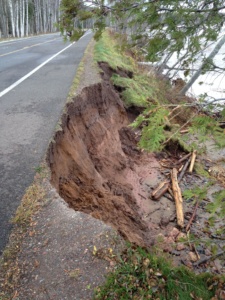
“Based on our engineer’s visual inspection, we are estimating $2,250,000 in repair costs for the work needed to stabilize the road and right-of-way,” said Brad Kluczynski, manager of the Grand Traverse County Road Commission. “On April 2nd, an additional 100 feet sheared off of Bluff Road on Old Mission Peninsula, and this could continue happening.”

“If Lake Michigan rises substantially higher, there will likely be additional sections that need to be addressed – including possible closure of a segment of the popular Bluff Road that runs along Old Mission Peninsula to our wineries and other agricultural and tourist destinations,” Kluczynski said.

“One section of Bluff Road was already closed this winter due to erosion that reached the edge of the driving surface and we have another dead-end spur off of Forest Avenue that was formerly a gentle slope into the water and is now a steep drop-off that may need to be closed for safety reasons,” he said. “We won’t know until we can get into the water to investigate.”

In the Upper Peninsula, tourism and access to some of Michigan’s most iconic sites are also threatened by high Great Lakes water levels.

“County Road 107 is the only access from the east into Michigan’s largest state park, the Porcupine Mountains Wilderness State Park including Lake of the Clouds and the ski slopes,” said Mike Maloney, PE, engineer-manager of the Ontonagon County Road Commission (OCRC). “The east side is where the majority of the park’s 450,000 visitors enter.”

“CR 107’s erosion is and will continue to have severe impacts to the community and the Michigan Department of Natural Resources,” Maloney said. “While we were unsuccessful in getting a federal BUILD Grant, we have secured the assistance of the Michigan National Guard and the Michigan Department of Natural Resources (MDNR) to restore 1,700 feet of shoreline this summer.”

The County Road 107 – also known as the 107th Engineers Memorial Highway – project has already cost OCRC (which has an $8 million annual budget) $800,000 including $200,000 from the MDNR in a project that begin this winter. Maloney pegs the fix at $5 million, although relocating the road further from Lake Superior at $13 million is the preferred fix. Click here to learn more about this unique partnership between the MDNR and the Ontonagon County Road Commission. https://www.michigan.gov/dnr/0,4570,7-350-86469-514514–,00.html

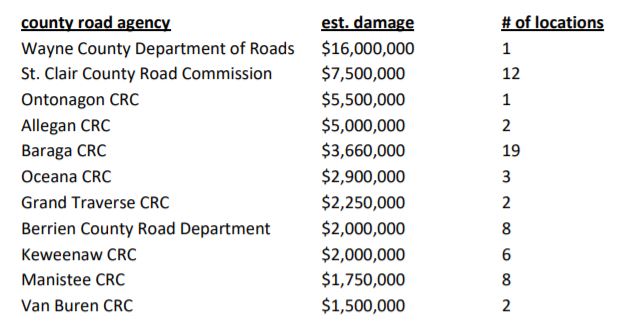
There are currently 11 counties that estimate more than $1 million in Great Lakes-caused damage to the county road system:
Road Commission of Kalamazoo County honored with IMPRESS Awards!


Pictured: David Pawloski, Travis Bartholomew, Mike Boersma, Ann Simmons, Mark Worden, Deb Buchholtz, Thom Brennan and Larry Stehouwer

The County Road Association (CRA) of Michigan honored the Road Commission of Kalamazoo County (RCKC) with statewide IMPRESS Awards at CRA’s 2020 Highway Conference. IMPRESS Awards recognize county road agencies that demonstrate innovation with special projects in communications, operations and collaboration.

RCKC received an IMPRESS Award in Communications and a People’s Choice Award for its “110 Years of Service” project. RCKC also earned an IMPRESS Award in Operations for “Roadside Vegetation Response.”

In 2019, RCKC celebrated 110 years of service. On October 10, 2019, the agency hosted an open house to let the public and partners learn more about the mission, history and day-to-day operations of RCKC. Their efforts in engaging the public earned them the IMPRESS Award in Communications.

In its “Roadside Vegetation Response” project, RCKC started using pink flags printed with agency information placed near fallen trees, directing property owners to contact them within 15 days to have the tree removed. The flag project provides citizens with a convenient solution to storm damage while also saving the resources of work crews.

“The Road Commission of Kalamazoo County has proven its dedication to engaging with the public in both its anniversary celebration and the tree removal program,” said Denise Donohue, CRA director. “Kalamazoo truly shows its attention to the safety and well-being of others. Their efforts to educate and protect the public make them a positive example for other road agencies.”

An independent panel of communications and operations experts from several of Michigan’s 83 county road agencies judged the projects. Award recipients were honored for projects that solved time restraints, labor costs, communication barriers and fostered collaboration.

Midland County Road Commission honored with two IMPRESS Awards!

Jon Myers, managing director of Midland County Road Commission (MCRC), accepts two IMPRESS Awards for MCRC.

The County Road Association (CRA) of Michigan honored the Midland County Road Commission (MCRC) with two statewide IMPRESS Awards at CRA’s 2020 Highway Conference. IMPRESS Awards recognize county road agencies that demonstrate innovation with special projects in communications, operations and collaboration.

MCRC received an IMPRESS Award in Collaboration for its “Recycled Plastic Pavement” project and an IMPRESS Award in Communications for its “Public Involvement Survey.” Additionally, the “Public Involvement Survey” project won a People’s Choice Award.

For its Collaboration award, MCRC partnered with Dow Chemical Company and Larkin Township to pilot the use of recycled plastics, food-grade foam and a new additive for road paving projects. MCRC was the first in the U.S. to use the foam-plus-additive on a public road.

MCRC earned an Award in Communications for a project that asked the public for opinions on a potential full interchange at US-10 and Waldo Road. To gauge public interest, MCRC created an online survey and distributed it through MCRC’s Midland County Fair booth, webpage, Facebook and Twitter accounts. Over 2,700 people responded to the survey, with the majority supporting the project.

“Our county road agencies work hard to improve local roads, and support their local communities,” said Denise Donohue, CRA director. “Midland County Road Commission was honored for its efforts to innovate and engage the public using new technology.”

An independent panel of communications and operations experts from several of Michigan’s 83 county road agencies judged the projects. Award recipients were honored for projects that solved time restraints, labor costs, communication barriers and fostered collaboration.

Gladwin County Road Commission and Roscommon County Road Commission receive IMPRESS Award

Tim O’Rourke, Roscommon County Road Commission, and Dave Pettersch, Gladwin County Road Commission

The County Road Association (CRA) of Michigan honored the Gladwin County Road Commission (GCRC) and Roscommon County Road Commission (RCRC) with a shared IMPRESS Award at CRA’s 2020 Highway Conference. IMPRESS Awards recognize county road agencies that demonstrate innovation with special projects in communications, operations and collaboration.

GCRC and RCRC shared the IMPRESS Award in Collaboration for their “Safety Project Collaboration Between Gladwin and Roscommon County Road Commissions along F-97.” They were also honored with a People’s Choice Award for their project.

GCRC and RCRC partnered to repave F-97, a well-traveled primary road between the two counties. F-97 has been known for narrow pavement and tight curves, and both road agencies were committed to improving the curves to enhance safety for the motoring public.

“GCRC and RCRC’s achievement is an example of how Michigan county road agencies are working well together,” said Denise Donohue, CRA director. “Their joint efforts have met our most important concern: The safety of drivers everywhere.”

An independent panel of communications and operations experts from several of Michigan’s 83 county road agencies judged the projects. Award recipients were honored for projects that solved time restraints, labor costs, communication barriers and fostered collaboration.

Senator Tom Barrett honored with Distinguished Service Award at CRA’s 2020 Highway Conference

Pictured: Tim Langholz, accepting a Distinguished Service Award on behalf of
Sen. Tom Barrett.

The County Road Association (CRA) of Michigan honored Senator Tom Barrett with a Distinguished Service Award at CRA’s 2020 Highway Conference.

Sen. Barrett is chair of the Michigan Senate Transportation and Infrastructure Committee. He was elected to the Michigan Senate in November 2018, representing the 24th District, which includes Clinton County, Eaton County, Shiawassee County; and Leroy Township, Locke Township, Wheatfield Township, Williamstown Township and the City of Williamston in Ingham County. Prior to his appointment to the Senate, Sen. Barrett served two terms as State Representative for the 71st District.

“Senator Barrett has been a key part of advancing our local road network,” said Denise Donohue, CRA director. “We are grateful for his contributions thus far and look forward to continuing to work with him to achieve the people’s goals to restore Michigan roads and bridges.”

Representative Jack O’Malley honored with Distinguished Service Award at CRA’s 2020 Highway Conference


 Representative Jack O’Malley receives a Distinguished Service Award.

The County Road Association (CRA) of Michigan honored Representative Jack O’Malley with a Distinguished Service Award at its 2020 Highway Conference.

Rep. O’Malley is chair of the Michigan House Transportation Committee. He was elected to the Michigan House of Representatives in November 2018, representing the 101st District, which includes Benzie, Leelanau, Manistee and Mason counties. Dedicated to serving county road agencies, Rep. O’Malley is eager to make improvements in the local road network in Michigan and has spent a great deal of time in the Legislature and in meetings around the state talking about county roads.

“We are grateful to Representative O’Malley for his advocacy and commitment to improving county roads,” Denise Donohue, CRA director, said. “He has been an ally in our efforts to restore Michigan’s county roads in a cost-effective manner, and we look forward to continuing to work with him in the future.”

CRA’s Distinguished Service Awards recognize road agency staff, commissioners and others who have dedicated their time and service in an outstanding manner to the advancement of the county road and bridge system in Michigan.